Compounded Tirzepatide: Cost, Safety, and Best Providers (2026)
Last updated: March 2026 · Written by Ash at ClearMetabolic
I have been on Mounjaro (brand-name tirzepatide) since 2024, and I track my results with regular DEXA scans. So I have firsthand experience with this molecule. Brand-name tirzepatide costs $1,023 to $1,060 per month without insurance (Mounjaro and Zepbound, respectively). That is out of reach for most people paying cash. Compounded tirzepatide has become the go-to alternative, offering the same dual-action molecule at $149 to $399 per month through telehealth providers.
This page covers everything about compounded tirzepatide in 2026: how the drug works, what compounding actually means, dosing, pricing, the best providers, and what to watch out for on the safety side.
Quick Facts
| Detail | Info |
|---|---|
| Generic Name | Tirzepatide (compounded) |
| Brand-Name Equivalents | Mounjaro (diabetes), Zepbound (weight management) |
| Drug Class | Dual GIP/GLP-1 receptor agonist |
| Regulatory Status | Permitted under FDA drug shortage policy (status updates periodically) |
| Pharmacy Types | 503A (state-regulated) and 503B (FDA-inspected outsourcing facilities) |
| Price Range | $149 to $399/month through telehealth |
| Brand-Name Price | $1,023 to $1,060/month (Mounjaro/Zepbound without insurance) |
| Route | Subcutaneous injection (weekly) |
| Clinical Weight Loss | ~22.5% body weight at max dose over 72 weeks (SURMOUNT-1 trial) |
How It Works
Tirzepatide is a dual GIP/GLP-1 receptor agonist. Unlike semaglutide (Ozempic, Wegovy), which only targets the GLP-1 receptor, tirzepatide activates two receptors at once: GLP-1 and GIP (glucose-dependent insulinotropic polypeptide).
Here is what each receptor does:
GLP-1 activation slows gastric emptying, reduces appetite signals in the brain, and improves insulin sensitivity. This is the same mechanism that semaglutide uses.
GIP activation adds a second pathway. GIP receptors are involved in fat metabolism, energy balance, and additional appetite regulation. The dual mechanism is what most researchers believe explains why tirzepatide produces roughly 50% more weight loss than semaglutide in head-to-head trials (20.2% vs 13.7% in SURMOUNT-5).
Think of it as having two separate brake pedals for hunger and fat storage, both pressed at the same time. The combined effect is stronger than either one alone.
Compounded tirzepatide contains the same molecule as Mounjaro and Zepbound. Eli Lilly manufactures the brand-name versions. Compounding pharmacies produce compounded tirzepatide under FDA shortage rules, mixing the active ingredient into injectable formulations. The pharmacology is identical.
How Compounding Works
Compounding pharmacies produce customized or shortage-listed medications. For tirzepatide, the FDA’s drug shortage policy is the legal basis. When Eli Lilly could not produce enough Mounjaro and Zepbound to meet surging demand, the FDA placed tirzepatide on its official shortage list. This authorized compounding pharmacies to produce it under Section 503A and 503B of the Federal Food, Drug, and Cosmetic Act.
503A vs 503B: The Key Distinction
503A pharmacies compound medications based on individual patient prescriptions. They are regulated by state boards of pharmacy, not the FDA. Quality standards vary by state. They are not required to follow FDA cGMP (current Good Manufacturing Practices) and do not undergo routine FDA inspections.
503B outsourcing facilities are registered with the FDA. They can produce medications in bulk without individual prescriptions. They must follow cGMP, submit to regular FDA inspections, and report adverse events to the FDA. This is a meaningfully higher bar for quality control.
For compounded tirzepatide, I strongly recommend choosing a provider that sources from a 503B facility. The FDA inspection requirement is a real quality backstop. With a 503A pharmacy, you are relying on your state’s pharmacy board for oversight, and enforcement quality varies.
Regulatory Future
The FDA reviews its shortage list periodically. If tirzepatide is removed from shortage status, the legal framework for compounding changes. The FDA has previously provided transition periods when removing drugs from the shortage list, giving patients time to find alternatives. Some compounding pharmacies may continue producing tirzepatide with added ingredients (like B12 or NAD+) under different legal provisions, but the regulatory picture is not settled.
Check the current FDA shortage status before starting compounded tirzepatide. Ask your provider what their contingency plan is if the shortage designation changes.
Typical Dosing
Compounded tirzepatide follows the same dose escalation as brand-name Mounjaro. You start low and increase every four weeks.
| Dose | Typical Duration | Notes |
|---|---|---|
| 2.5 mg/week | 4 weeks | Starting dose. Primarily for tolerability, not full therapeutic effect. |
| 5 mg/week | 4 weeks | First therapeutic dose. Appetite suppression becomes noticeable. |
| 7.5 mg/week | 4 weeks | Intermediate dose. Many people see strong results here. |
| 10 mg/week | 4 weeks | Higher therapeutic dose. 19.5% weight loss in SURMOUNT-1. |
| 12.5 mg/week | 4 weeks | Second-highest dose. Close to maximum efficacy. |
| 15 mg/week | Maintenance | Maximum dose. 22.5% weight loss in SURMOUNT-1. |
From my own experience on Mounjaro, the 5 mg dose was where I first noticed a real shift in appetite. I am currently on a higher dose and track my body composition with DEXA scans every few months. The weight loss has been consistent, but I also prioritize strength training and protein intake to preserve lean mass. The medication handles appetite. You still have to handle the rest.
Not everyone needs to go to 15 mg. Your prescriber should titrate based on your response, side effect tolerance, and weight loss trajectory. Some people do well staying at 7.5 mg or 10 mg long-term.
What It Costs in 2026
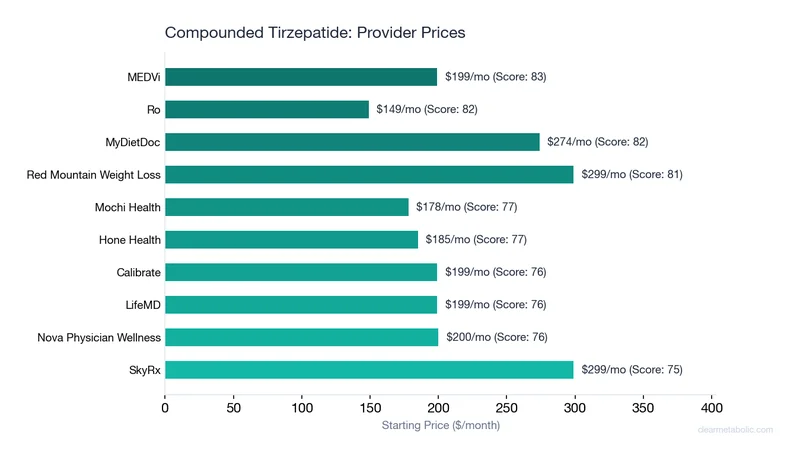
Compounded tirzepatide is typically a bit more expensive than compounded semaglutide, reflecting the higher complexity of the molecule. Here is what the top providers charge as of early 2026.
| Provider | ClearScore | Monthly Cost | What's Included |
|---|---|---|---|
| MEDVi | 83/100 | $249/mo | Medication, provider consultations, body composition tracking |
| Ro | 82/100 | $149/mo | Medication, online evaluation, home delivery |
| Red Mountain Weight Loss | 81/100 | $299/mo | Medication, clinical support, in-person clinic option |
| Mochi Health | 77/100 | $49-$69/mo membership + $99-$199/mo medication | Split pricing model: low membership fee plus separate medication cost |
| Calibrate | 76/100 | $199/mo | Medication, metabolic coaching, structured program |
For context, brand-name Mounjaro costs about $1,023/month and Zepbound about $1,060/month at retail. Compounded tirzepatide saves you $700 to $900 per month compared to brand.
A few things to keep in mind on pricing. Some providers have split pricing models (membership fee plus medication cost), so compare the total monthly spend. Prices can also increase at higher doses with some providers. Always confirm what you will pay at your maintenance dose, not just the introductory rate.
For a full breakdown of affordable GLP-1 options, see our cheapest GLP-1 online guide.
Looking for the best price on compounded tirzepatide?
Compare 40+ telehealth providers side by side, sorted by price and ClearScore.
Compare Providers →Where to Get It Online: Top 5 Providers by ClearScore
Here are the highest-rated providers offering compounded tirzepatide, ranked by our ClearScore methodology.
1. MEDVi (ClearScore: 83/100)
MEDVi offers compounded tirzepatide at $249/month with clinical support that includes body composition tracking and regular provider check-ins. They source from 503B outsourcing facilities. If you want a more clinically involved experience (not just a medication subscription), MEDVi is a strong option.
2. Ro (ClearScore: 82/100)
Ro offers compounded tirzepatide at $149/month, making it the most affordable option among the top-rated providers. Their platform covers the medical evaluation, prescriber consultation, and direct home delivery. Ro is one of the most established telehealth platforms in the space.
3. Red Mountain Weight Loss (ClearScore: 81/100)
Red Mountain combines telehealth with physical clinic locations. Compounded tirzepatide is $299/month, the most expensive option on this list. The premium gets you more hands-on clinical oversight and the option to visit a clinic in person. If you prefer face-to-face support, Red Mountain is worth considering.
4. Mochi Health (ClearScore: 77/100)
Mochi uses a split pricing model: a monthly membership of $49 to $69 plus medication costs of $99 to $199 per month. Total monthly spend ranges from roughly $148 to $268 depending on your plan and dose. This model can be cost-effective at lower doses but watch the total at higher ones.
5. Calibrate (ClearScore: 76/100)
Calibrate pairs compounded tirzepatide ($199/month) with a structured metabolic health program that includes coaching, curriculum, and ongoing provider support. The program is designed around behavior change in addition to medication. If you want more structure and accountability, Calibrate offers that framework.
Read our full Calibrate review
Safety Considerations
Compounded tirzepatide uses the same active molecule as Mounjaro and Zepbound. But the manufacturing process is different, and that has safety implications.
Quality Varies Between Pharmacies
The biggest safety variable is the pharmacy producing your medication. A 503B outsourcing facility under FDA inspection follows cGMP and is held to manufacturing standards similar to (though not identical to) what Eli Lilly follows. A small 503A pharmacy regulated only by its state board has far less oversight.
The FDA has issued warnings about compounding pharmacies producing GLP-1 medications with potency issues, sterility concerns, and improper labeling. These problems are not universal, but they are real.
What to Look For
Before starting compounded tirzepatide, ask your provider:
- Is the pharmacy a 503B outsourcing facility? This is the strongest quality indicator. 503B facilities are FDA-registered and follow cGMP.
- Do they provide certificates of analysis? Reputable compounders test each batch for potency, sterility, and endotoxins. You should be able to see these results.
- What is the pharmacy’s FDA inspection history? You can look up 503B facilities on the FDA website and check their inspection records.
- Does the provider require a medical evaluation? Any legitimate program requires a prescriber to review your medical history before prescribing. No prescription means no oversight.
The Semaglutide Sodium Parallel
The FDA raised concerns about some compounders using a different salt form (semaglutide sodium vs semaglutide base). A similar risk exists with tirzepatide. Make sure your provider can confirm they are using the same form of tirzepatide as the FDA-approved product. Ask directly if you are unsure.
Common Side Effects
The side effects of compounded tirzepatide match those of brand-name Mounjaro and Zepbound. The molecule is identical. Here is what to expect:
- Nausea is the most common side effect. It typically peaks during the first week or two at each new dose level and improves as your body adjusts. Eating smaller, less greasy meals helps significantly.
- Diarrhea is common early in treatment, especially after dose increases.
- Constipation affects some people. Staying hydrated and increasing fiber intake usually manages it.
- Decreased appetite is the therapeutic effect, but it can feel aggressive at first. In my first few weeks on Mounjaro, I had to remind myself to eat.
- Injection site reactions (redness, minor itching) are usually mild and short-lived.
- Fatigue and headaches are reported by some people, particularly at higher doses.
- Vomiting occurs in a small percentage of patients, more often at the 10 mg, 12.5 mg, and 15 mg doses.
Serious side effects are rare. They include pancreatitis, gallbladder issues, and a boxed warning about thyroid C-cell tumors seen in rodent studies. The same warnings apply to brand-name Mounjaro.
For a detailed breakdown of what to expect, read our GLP-1 side effects guide.
Compounded Tirzepatide vs Brand-Name Mounjaro
The molecule is the same. The differences are in manufacturing, delivery format, and cost.
Brand-name Mounjaro is made by Eli Lilly in FDA-approved manufacturing facilities. It comes in single-dose auto-injector pens (no measuring required), is backed by the SURMOUNT clinical trial data, and costs $1,023/month without insurance.
Compounded tirzepatide is produced by compounding pharmacies. It typically comes in multi-dose vials, which means you draw up your own dose with a syringe. It costs $149 to $399 per month. The trade-off is doing more of the work yourself (measuring doses, storing vials properly) and relying on the compounding pharmacy’s quality standards rather than Eli Lilly’s.
For a deep comparison, see our compounded vs brand-name GLP-1 guide. And for a broader comparison of the two major GLP-1 molecules, check out our Mounjaro vs Ozempic breakdown.
Frequently Asked Questions
Is compounded tirzepatide the same as Mounjaro?
Compounded tirzepatide contains the same active ingredient as Mounjaro. The molecule and mechanism of action are identical. The difference is manufacturing. Eli Lilly produces Mounjaro in FDA-approved facilities with rigorous manufacturing controls. Compounding pharmacies produce compounded tirzepatide under either state (503A) or FDA (503B) oversight. The SURMOUNT clinical trials were run with the Eli Lilly product. Compounded versions have not been separately studied in clinical trials, but the drug is the same.
Why is compounded tirzepatide more expensive than compounded semaglutide?
Tirzepatide is a more complex molecule than semaglutide. It has a dual receptor mechanism (GIP and GLP-1), which makes the active pharmaceutical ingredient more expensive to source and compound. The price difference between compounded semaglutide ($149 to $299/month) and compounded tirzepatide ($149 to $399/month) reflects this added manufacturing complexity. That said, competition among telehealth providers has pushed tirzepatide prices down significantly over the past year.
What happens if I stop taking compounded tirzepatide?
Weight regain is common after stopping any GLP-1 medication. Data from the SURMOUNT-4 trial showed that patients who switched from tirzepatide to placebo regained about half of their lost weight over the following year. This is why most prescribers treat tirzepatide as a long-term medication. Your provider should discuss a maintenance strategy with you. Some patients stay on a lower maintenance dose long-term. Others work toward a gradual taper with close monitoring.
Can I switch from compounded semaglutide to compounded tirzepatide?
Yes. Many people switch, especially if they have plateaued on semaglutide and want to try the dual-action mechanism. Your provider will typically start you at the 2.5 mg starting dose of tirzepatide regardless of what semaglutide dose you were on. The two drugs work on different receptor profiles, and your body needs time to adjust. Discuss the transition timeline with your prescriber.
Is compounded tirzepatide safe long-term?
Long-term safety data comes primarily from the SURMOUNT and SURPASS clinical trials conducted with Eli Lilly’s brand-name product. Those trials ran 72 weeks and showed a favorable safety profile, with GI side effects being the main concern. Compounded tirzepatide uses the same molecule, so the drug’s safety profile should be comparable. The additional variable is the quality of the compounding pharmacy. Choosing a 503B facility with FDA oversight reduces that risk. For most people without access to insurance-covered brand-name Mounjaro, compounded tirzepatide from a reputable provider is a reasonable long-term option. Discuss your individual risk factors with your prescriber.