Medication Profile · Updated August 2026
Ozempic (Semaglutide): Cost, Dosing, and Where to Get It in 2026
Ozempic costs $349 per month for the 0.25 mg, 0.5 mg, and 1 mg pens when you buy directly from Novo Nordisk's NovoCare Pharmacy without insurance, and $499 for the 2 mg pen. New self-pay patients pay $199 per month for the first two months, and the new Ozempic tablets start at $149. I am personally on Mounjaro (tirzepatide), but half the people who message me about GLP-1s are asking about Ozempic. The pricing picture changed more in the past 18 months than in the previous five years, with direct-from-Novo pricing replacing most of the compounded market. Here is where things stand in August 2026.
Quick Facts
| Detail | Ozempic |
|---|---|
| Generic Name | Semaglutide |
| Brand Name | Ozempic |
| Manufacturer | Novo Nordisk |
| FDA Approval | December 2017 (type 2 diabetes) |
| Drug Class | GLP-1 receptor agonist |
| Administration | Weekly subcutaneous injection (pre-filled pen) |
| Available Doses | Injection: 0.25, 0.5, 1, 2 mg. Tablets: 1.5, 4, 9 mg |
| Brand Price (no insurance) | $349 to $499/month via NovoCare Pharmacy (list price ~$998) |
| Ozempic Tablets (self-pay) | $149 to $299/month by dose |
| With Insurance Copay | As little as $25/month with the savings offer (commercial plans) |
| Weight Loss (trials) | ~15% body weight at 68 weeks (STEP 8) |
How Ozempic Works
Ozempic is a GLP-1 receptor agonist. It mimics a hormone your body naturally produces called glucagon-like peptide-1 (GLP-1). When you inject semaglutide, it activates GLP-1 receptors in the brain and gut, producing three main effects:
- Appetite reduction. GLP-1 signals satiety to the hypothalamus in your brain. You feel full sooner and think about food less. This is the primary driver of weight loss.
- Slower gastric emptying. Food stays in your stomach longer, which keeps you feeling satisfied between meals and reduces blood sugar spikes after eating.
- Improved insulin response. Your pancreas releases insulin more effectively in response to food. This is why Ozempic was originally approved for type 2 diabetes.
The weight loss from Ozempic is dose-dependent. Higher doses produce more appetite suppression and more weight loss, which is why the dosing schedule starts low and gradually increases over several months.
For a deeper breakdown of the single-action GLP-1 mechanism vs. dual-action drugs like Mounjaro, see our Mounjaro vs Ozempic comparison.
Dosing Schedule
Ozempic uses a step-up dosing protocol to minimize side effects. You start at the lowest dose and increase every four weeks until you reach a therapeutic level.
| Week | Dose | Purpose |
|---|---|---|
| Weeks 1 to 4 | 0.25 mg | Initiation dose. Lets your body adjust. Minimal weight loss expected. |
| Weeks 5 to 8 | 0.5 mg | First therapeutic dose. Appetite suppression starts becoming noticeable. |
| Weeks 9 to 12 | 1 mg | Standard maintenance dose for most patients. Many stay here. |
| Week 13+ | 2 mg | Maximum dose. Used if 1 mg is insufficient for blood sugar or weight goals. |
Most providers keep patients at 1 mg unless there is a clear clinical reason to increase. The jump from 1 mg to 2 mg often brings more side effects without a proportional increase in benefit for everyone. Your prescriber should base this decision on your blood sugar response and weight trajectory.
One important note: Ozempic’s maximum dose (2 mg) is lower than Wegovy’s. Wegovy was specifically designed for weight management, includes the 1.7 mg and 2.4 mg maintenance levels that Ozempic does not have, and added a 7.2 mg high dose in 2026. If weight loss is your primary goal and you have plateaued at 2 mg Ozempic, your doctor may consider switching you to Wegovy for the higher dosing options.
Weight Loss Results
Ozempic was originally approved for type 2 diabetes, not weight management. But the clinical trial data shows meaningful weight loss across multiple studies.
STEP 8 Trial (semaglutide 2.4 mg vs. daily liraglutide):
- Participants on semaglutide 2.4 mg (the Wegovy dose) lost approximately 15.8% of body weight at 68 weeks
- Participants on liraglutide 3 mg (Saxenda) lost approximately 6.4% over the same period
Correction (August 2026): an earlier version of this page described STEP 8 as a comparison of semaglutide 2.4 mg against 1 mg. STEP 8 compared semaglutide against liraglutide. The 1 mg figures below come from the SUSTAIN program.
SUSTAIN Trials (Ozempic-specific):
- SUSTAIN 1: 3.7 kg (8.2 lbs) weight loss at 30 weeks with 0.5 mg
- SUSTAIN 2: 4.3 to 6.1 kg (9.5 to 13.4 lbs) weight loss at 56 weeks
What does this mean in real terms? The headline semaglutide numbers come from the 2.4 mg Wegovy dose. On Ozempic’s standard 1 mg dose, the SUSTAIN data points to roughly 10 to 13 lbs over a year, though real-world results in people without diabetes often run higher. At Wegovy’s 2.4 mg dose, a 220 lb person averages closer to 35 lbs at 68 weeks.
These are averages. Individual results vary significantly based on diet, exercise, starting weight, and how your body responds to the medication. From my own experience tracking DEXA scans while on a GLP-1, the composition of that weight loss matters as much as the number on the scale. If you are not doing resistance training, a meaningful portion of the weight you lose will be muscle. Our fat loss vs weight loss guide breaks this down in detail.
For context on how Ozempic compares to Mounjaro’s clinical trial results (roughly 22.5% body weight loss at the highest dose), see the full comparison.
What Ozempic Costs in 2026
The cost picture for Ozempic changed completely between early 2025 and mid 2026. Here is what you are actually looking at as of August 2026.
Brand-Name Ozempic
The list price for brand-name Ozempic is roughly $998 per month, but almost nobody pays that anymore. Novo Nordisk now sells Ozempic directly to cash-pay patients through NovoCare Pharmacy at $349 per month for the 0.25 mg, 0.5 mg, and 1 mg pens and $499 per month for the 2 mg pen (verified August 2026). New self-pay patients get an introductory rate of $199 per month for the first two months, an offer Novo currently lists as running through December 31, 2026. For the full cash-pay picture across 94 providers, see our 2026 GLP-1 Cash-Pay Pricing Index.
Novo Nordisk Savings Card: If you have commercial insurance (not Medicare or Medicaid) and your plan covers Ozempic, the savings offer covers up to $100 per monthly fill, capped at $1,001 per year. That can bring your copay down to as little as $25 per month. Check NovoCare.com for current eligibility.
With insurance: Most commercial insurance plans cover Ozempic for type 2 diabetes. Typical copays range from $25 to $100 per month depending on your plan’s formulary tier. Coverage for weight loss (off-label use) is less consistent. See our insurance coverage guide for strategies to get approved. If you are on Medicare, semaglutide was included in the second round of Medicare price negotiation, with a negotiated price of $274 per month taking effect January 1, 2027. Your Part D plan still sets the actual copay and can require prior authorization.
The Ozempic Pill (New in 2026)
Novo Nordisk launched Ozempic tablets nationwide on May 4, 2026. The FDA approved this next-generation oral semaglutide (an upgraded, smaller version of the Rybelsus formulation) in February 2026 in 1.5 mg, 4 mg, and 9 mg doses. Self-pay pricing through NovoCare Pharmacy is $149 per month for 1.5 mg, $199 for 4 mg, and $299 for 9 mg. Like the injection, the tablets are approved for type 2 diabetes. The tradeoff is a daily pill instead of a weekly injection, which some people prefer and others find harder to stay consistent with.
What Happened to Compounded Semaglutide
For about two years, compounded semaglutide at $149 to $299 per month was the budget path to this medication. That era is mostly over. The FDA declared the semaglutide shortage resolved in February 2025, which removed the legal basis for mass compounding. The large telehealth platforms wound down their compounded programs through 2025 and 2026, and in April 2026 the FDA proposed removing semaglutide from the 503B bulk compounding list entirely.
A narrow lane remains. Some providers still prescribe patient-specific compounded semaglutide through 503A pharmacies, typically around $179 to $299 per month. The key tradeoff is unchanged: compounded semaglutide has not gone through FDA review as a finished product. For a detailed breakdown, read our compounded vs brand-name guide. With Novo’s direct price now at $349, the savings gap that drove the compounded market has mostly closed.
Cost Comparison Summary
| Option | Monthly Cost | Notes |
|---|---|---|
| Brand-name pen (NovoCare self-pay) | $349 to $499 | $199/month intro rate for the first two months |
| Brand-name (insurance + savings card) | $25 to $100 | Commercial insurance required. Card covers up to $100 per fill. |
| Ozempic tablets (self-pay) | $149 to $299 | By dose: 1.5, 4, or 9 mg. Launched May 2026. |
| Compounded semaglutide (503A) | $179 to $299 | Limited availability. Being phased out under FDA pressure. |
For a full pricing breakdown across all providers and medication types, see our cheapest GLP-1 online guide.
Compare semaglutide prices from verified providers
See Provider Comparison →Where to Get Ozempic (or Compounded Semaglutide) Online
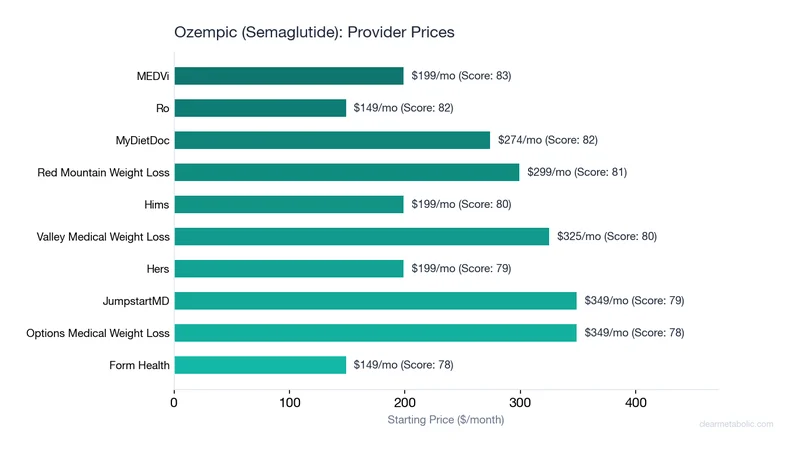
These are the top-rated telehealth providers for semaglutide, ranked by our ClearScore methodology. The mix changed in 2026: most large platforms now prescribe brand-name medication at Novo’s direct prices, while a few still offer compounded semaglutide through 503A pharmacies. You can also skip telehealth entirely and buy directly from Novo through NovoCare Pharmacy with a prescription from your own doctor.
| Provider | ClearScore | Monthly Price | Key Details |
|---|---|---|---|
| MEDVi | 83 | $179 first month, then $299/mo | Doctor-led. Still offers compounded semaglutide (injectable and tablets) via 503A pharmacies. |
| Ro | 82 | Brand-name rates + membership | Exited compounded semaglutide. Now prescribes brand-name GLP-1s with a membership fee on top. |
| Red Mountain | 81 | ~$299/mo | In-person and telehealth. Established weight loss clinic network. |
| Hims | 80 | From $299/mo | Brand-name only since settling with Novo Nordisk in March 2026. Polished app. |
| Hers | 79 | From $299/mo | Same company as Hims, branded for women. Same medications and pricing. |
For a full comparison of every GLP-1 telehealth provider we track (with pricing, insurance acceptance, and coverage maps), visit our provider directory.
Common Side Effects
GLP-1 medications share a similar side effect profile. Most side effects are gastrointestinal and tend to be worst during the first few weeks of each dose increase. They typically improve as your body adjusts.
Most common (affecting 10% or more of patients in trials):
- Nausea (the most frequently reported, especially in the first 4 to 8 weeks)
- Diarrhea
- Vomiting
- Constipation
- Abdominal pain
Less common but reported:
- Headache
- Fatigue
- Dizziness
- Injection site reactions (redness, swelling)
- Decreased appetite (this is technically the mechanism working, not a side effect)
Serious but rare:
- Pancreatitis (inflammation of the pancreas). Seek medical attention for severe, persistent abdominal pain.
- Gallbladder problems, including gallstones
- Changes in vision in patients with type 2 diabetes (diabetic retinopathy)
- Kidney problems, usually related to dehydration from nausea/vomiting
Boxed warning: Semaglutide carries a boxed warning about thyroid C-cell tumors observed in rodent studies. This risk has not been confirmed in humans, but Ozempic is contraindicated in patients with a personal or family history of medullary thyroid carcinoma (MTC) or Multiple Endocrine Neoplasia syndrome type 2 (MEN 2).
For a month-by-month breakdown of what to expect (and what actually helped me manage GI side effects on Mounjaro), read our GLP-1 side effects guide.
Ozempic vs. Related Medications
Ozempic exists in a family of GLP-1 drugs. Here is how it compares.
Ozempic vs. Wegovy: Same active ingredient (semaglutide), different approved uses. Wegovy is FDA-approved for weight management and now runs up to a 7.2 mg high dose added in 2026. Ozempic maxes out at 2 mg and is approved for diabetes. If weight loss is your goal, Wegovy is the version designed for you. Full Wegovy profile.
Ozempic vs. Mounjaro: Mounjaro (tirzepatide) works on two receptors (GIP and GLP-1) compared to Ozempic’s one (GLP-1 only). Clinical trials show roughly 22.5% body weight loss with Mounjaro vs. 15% with semaglutide. Full comparison.
Ozempic vs. Compounded Semaglutide: Ozempic is manufactured by Novo Nordisk and FDA-approved. Compounded semaglutide is not an FDA-approved generic, and FDA does not review compounded products for safety, effectiveness, quality, or bioequivalence before marketing. Compounding may occur under the 503A or 503B frameworks when applicable requirements are met. Compounded vs brand-name guide.