Medication Profile · Updated March 2026
Mounjaro (Tirzepatide): Cost, Dosing, and Where to Get It in 2026
I have been on Mounjaro since 2024. I started at 2.5 mg, titrated up through the dose schedule, and track my progress with regular DEXA scans. This page is the resource I wish existed when I was researching the drug before starting. It covers what Mounjaro actually is, what it costs right now, the full dosing schedule, weight loss data from the clinical trials, and where to get it online for the best price.
If you are comparing Mounjaro to other GLP-1s, check out our full four-drug comparison.
Quick Facts
| Detail | Mounjaro |
|---|---|
| Generic Name | Tirzepatide |
| Brand Name | Mounjaro |
| Manufacturer | Eli Lilly and Company |
| Drug Class | Dual GIP/GLP-1 receptor agonist |
| FDA Approval | May 2022 (type 2 diabetes) |
| Administration | Weekly subcutaneous injection (pre-filled pen) |
| Available Doses | 2.5 mg, 5 mg, 7.5 mg, 10 mg, 12.5 mg, 15 mg |
| Brand Price | ~$1,023/month (without insurance) |
| Compounded Price | $149 to $399/month |
| With Insurance (Copay) | $25 to $150/month |
| Weight Loss (15 mg) | 22.5% body weight at 72 weeks (SURMOUNT-1) |
| Same Molecule As | Zepbound (weight management indication) |
How Mounjaro Works
Mounjaro is a dual GIP/GLP-1 receptor agonist. In plain language, it activates two gut hormones at once: GLP-1 (glucagon-like peptide-1) and GIP (glucose-dependent insulinotropic polypeptide).
GLP-1 slows down how quickly food leaves your stomach, reduces your appetite, and improves how your body uses insulin. This is the same mechanism that Ozempic and Wegovy target.
GIP adds a second layer. It further suppresses appetite and appears to influence how your body stores and metabolizes fat. This dual action is why tirzepatide produces more weight loss than semaglutide (which only targets GLP-1) in clinical trials.
Think of it as two keys turning two locks simultaneously. You get stronger appetite suppression, better blood sugar control, and more fat loss than you would from either mechanism alone.
Mounjaro is FDA-approved specifically for type 2 diabetes. Doctors prescribe it off-label for weight loss all the time, and the clinical trial data supports that use. If you want a version that is officially approved for weight management, that is Zepbound, which contains the exact same molecule.
For a deeper look at how GLP-1 medications affect your body composition, read our guide on fat loss vs weight loss on GLP-1s.
Dosing Schedule
Mounjaro follows a gradual titration schedule. You start at the lowest dose and increase every four weeks, giving your body time to adjust. Your prescriber may keep you at a lower dose longer if side effects are rough, or move you up faster if you are tolerating it well.
| Dose | Duration | Purpose |
|---|---|---|
| 2.5 mg | Weeks 1 to 4 | Starting dose. Lets your body adjust. Not a therapeutic dose for weight loss. |
| 5 mg | Weeks 5 to 8 | First therapeutic dose. Most people start noticing appetite changes here. |
| 7.5 mg | Weeks 9 to 12 | Intermediate dose. Continued weight loss for most patients. |
| 10 mg | Weeks 13 to 16 | Higher dose. Strong appetite suppression. Common maintenance dose. |
| 12.5 mg | Weeks 17 to 20 | For patients who need additional weight loss beyond 10 mg. |
| 15 mg | Week 21+ | Maximum dose. Produced 22.5% weight loss in clinical trials. |
A few things I have learned from personal experience: The 2.5 mg starting dose does very little for appetite. Do not get discouraged. The real effects kick in at 5 mg and above. Side effects (mostly nausea) tend to spike in the first week after each dose increase and then settle down. Eating smaller meals and staying hydrated makes a big difference during those transition weeks.
For our full dosing breakdown with tips for each level, see the Mounjaro Dosage Guide.
Weight Loss Results: What the Clinical Trials Show
The SURMOUNT-1 trial, published in the New England Journal of Medicine in 2022, studied tirzepatide in adults with obesity or overweight (BMI of 30 or higher, or 27 or higher with a weight-related condition) who did not have diabetes.
Results at 72 weeks:
| Dose | Avg. Weight Loss | % Losing 20%+ Body Weight |
|---|---|---|
| 5 mg | 15.0% | ~27% |
| 10 mg | 19.5% | ~37% |
| 15 mg | 22.5% | ~36% |
| Placebo | 3.1% | ~2% |
Over one-third of participants on the 15 mg dose lost more than 25% of their body weight. For a 220-pound person, that is roughly 50 pounds.
The SURMOUNT-5 trial later confirmed these results in a head-to-head comparison against semaglutide (Wegovy). Tirzepatide produced 20.2% weight loss versus 13.7% for semaglutide over 72 weeks. That is roughly 47% more weight loss with the same molecule that is in Mounjaro.
These are averages, though. Individual results depend on your starting weight, dose, diet, exercise habits, and how long you stay on treatment. Some people respond strongly at lower doses. Others need to reach 12.5 or 15 mg before seeing significant results.
One thing the scale does not tell you: how much of that weight loss is fat versus lean mass. I track this with DEXA scans, and the data has been eye-opening. For more on that, read my DEXA scan results after 6 months on Mounjaro.
What Mounjaro Costs in 2026
Cost is the biggest barrier for most people. Here is a clear breakdown of what you are looking at.
Brand-Name Mounjaro
The list price for brand-name Mounjaro (made by Eli Lilly, dispensed from a retail or specialty pharmacy) is approximately $1,023 per month without insurance. This price is the same regardless of dose.
With Insurance
If your insurance covers Mounjaro, your copay typically ranges from $25 to $150 per month. Coverage is most common when prescribed for type 2 diabetes (the FDA-approved indication). Off-label coverage for weight loss varies widely by plan.
Eli Lilly offers a savings card for commercially insured patients that can bring out-of-pocket costs down to as low as $25 per month. Check their website for current eligibility terms.
For a full walkthrough of the insurance process, see our GLP-1 insurance coverage guide.
Compounded Tirzepatide
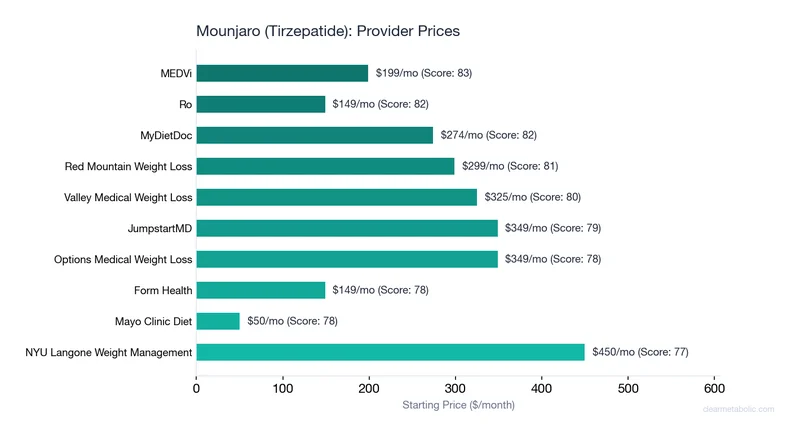
Compounded tirzepatide is the same active molecule produced by a licensed compounding pharmacy. Prices range from $149 to $399 per month depending on your provider and dose.
This is how most people without insurance coverage afford tirzepatide. The FDA has allowed compounding under its drug shortage policy. The regulatory situation has shifted over 2025 and 2026, but compounded tirzepatide remains available through multiple telehealth providers as of March 2026.
For a full comparison of compounded versus brand-name options, read our compounded vs brand-name GLP-1 guide.
Without Insurance
If you do not have insurance coverage and want brand-name Mounjaro, your options are the full list price (~$1,023/month) or Eli Lilly’s direct-pay programs. For most people paying out of pocket, compounded tirzepatide at $149 to $399/month is the practical choice.
See our complete guide on getting GLP-1 medications without insurance.
Looking for the best price on tirzepatide?
Compare 40+ online GLP-1 providers by price, ClearScore rating, and medication options.
Compare Providers →Where to Get Mounjaro Online: Top Providers by ClearScore
These are the highest-rated telehealth providers offering compounded tirzepatide (the same active ingredient as Mounjaro) as of March 2026. ClearScore is our internal rating based on pricing, transparency, medical oversight, pharmacy quality, and user experience.
| Provider | ClearScore | Starting Price | Highlights |
|---|---|---|---|
| MEDVi | 83/100 | $249/mo | Strong clinical support, body composition tracking, 503B pharmacy |
| Ro | 82/100 | $149/mo | Largest telehealth platform, brand-name and compounded options, insurance concierge |
| Red Mountain Weight Loss | 81/100 | $299/mo | Medical weight loss specialists, in-person and online options |
| Mochi Health | 77/100 | $49 to $69/mo + $99 to $199/mo meds | Low membership fee, medication billed separately, growing platform |
| Calibrate | 76/100 | $199/mo | Metabolic health focus, coaching included, structured program |
For the full list of 40+ providers with current pricing, visit our provider comparison directory. If affordability is your top priority, our guide on the cheapest GLP-1 options online breaks down every budget-friendly path.
Common Side Effects
The side effects of Mounjaro are mostly gastrointestinal and tend to be worst during the first one to two weeks after each dose increase. They usually improve as your body adjusts.
Most common:
- Nausea (reported by roughly 12 to 18% of participants in clinical trials, depending on dose). This was the most noticeable side effect in my experience. It peaked in the first week after moving to a new dose and faded by week two or three.
- Diarrhea (roughly 12 to 17%). More common at higher doses and in the early weeks.
- Constipation (roughly 6 to 11%). Some people get the opposite GI issue. Fiber and hydration help.
- Decreased appetite. This is the intended effect, but it can feel extreme in the beginning. Forcing yourself to eat at least some protein at each meal matters for muscle preservation.
- Injection site reactions. Mild redness or itching. Usually minor and temporary.
- Fatigue. Some people report low energy in the first few weeks, especially when eating less than usual.
Serious side effects (rare but worth knowing):
- Pancreatitis (stop the medication and seek medical attention for severe abdominal pain)
- Gallbladder problems (rapid weight loss increases gallstone risk)
- Thyroid C-cell tumors (seen in rodent studies, boxed warning on the label)
- Hypoglycemia (higher risk if combined with insulin or sulfonylureas)
Mounjaro is contraindicated if you have a personal or family history of medullary thyroid carcinoma or Multiple Endocrine Neoplasia syndrome type 2.
For a more detailed breakdown with management tips, read our GLP-1 side effects guide.
How Mounjaro Compares to Other GLP-1 Drugs
Mounjaro vs Ozempic: Mounjaro (tirzepatide) works on two receptors (GIP + GLP-1) while Ozempic (semaglutide) works on one (GLP-1 only). In clinical trials, Mounjaro produced roughly 22.5% weight loss at the highest dose compared to about 15% for semaglutide. See our full Mounjaro vs Ozempic comparison.
Mounjaro vs Zepbound: These are the same molecule. Mounjaro is FDA-approved for type 2 diabetes. Zepbound is approved for chronic weight management. Your prescriber will recommend one over the other based on your diagnosis and insurance situation. See our Mounjaro vs Zepbound breakdown.
Mounjaro vs Wegovy: Different molecules, different mechanisms. Mounjaro (dual GIP/GLP-1) outperformed Wegovy (GLP-1 only) in the SURMOUNT-5 head-to-head trial: 20.2% versus 13.7% weight loss. Wegovy has the cardiovascular outcome data advantage from the SELECT trial. Read the full four-way comparison for all the details.
If you are hitting a plateau on Mounjaro, we have a dedicated guide for that: Mounjaro Weight Loss Plateau.
Frequently Asked Questions
Is Mounjaro FDA-approved for weight loss?
No. Mounjaro is FDA-approved for type 2 diabetes only. It is widely prescribed off-label for weight loss, and the clinical trial data (SURMOUNT-1) supports this use. The weight-management-approved version of the same drug is called Zepbound.
What is the difference between Mounjaro and Zepbound?
They are the same molecule (tirzepatide) made by the same company (Eli Lilly). Mounjaro has the type 2 diabetes indication. Zepbound has the chronic weight management indication. Same drug, same doses, different FDA label. Your insurance coverage may differ based on which one is prescribed.
How long does it take for Mounjaro to start working?
Most people notice reduced appetite within the first one to two weeks. Measurable weight loss typically begins within the first month. The SURMOUNT-1 trial showed progressive weight loss continuing through the full 72-week study period. Maximal results tend to come at the 10 to 15 mg doses after several months of treatment.
Can I get Mounjaro without insurance?
Yes. You have three main options: paying the full brand-name list price (~$1,023/month), using Eli Lilly’s savings programs (if eligible), or getting compounded tirzepatide from a telehealth provider ($149 to $399/month). Most people paying out of pocket choose the compounded route. See our guide to GLP-1s without insurance for a full walkthrough.
Should I exercise while on Mounjaro?
Yes, and resistance training is especially important. GLP-1 medications cause weight loss, and roughly 25 to 40% of that can be lean mass (muscle) if you are not actively training. Strength training and adequate protein (aim for at least 0.7g per pound of body weight daily) help preserve muscle. I have seen this clearly in my own DEXA scan data. Read our guide on exercise and muscle preservation on GLP-1s for specific recommendations.
Last updated: March 2026. Pricing and availability may change. This article is for informational purposes only and does not constitute medical advice. Always consult a licensed healthcare provider before starting any medication.