Medication Profile · Updated March 2026
Zepbound (Tirzepatide): Cost, Dosing, and Weight Loss Results in 2026
Zepbound is tirzepatide, the same molecule that is in Mounjaro. The difference is the FDA label: Zepbound is approved specifically for chronic weight management, while Mounjaro is approved for type 2 diabetes. I take tirzepatide myself (prescribed as Mounjaro) and have tracked my results with DEXA scans for over a year. This page covers everything you need to know about Zepbound: what it costs, how the dosing works, what the clinical trial data shows, and where to get it at the best price in 2026.
If you want to compare Zepbound to other GLP-1 medications, see our full four-drug comparison.
Quick Facts
| Detail | Zepbound |
|---|---|
| Generic Name | Tirzepatide |
| Brand Name | Zepbound |
| Manufacturer | Eli Lilly and Company |
| Drug Class | Dual GIP/GLP-1 receptor agonist |
| FDA Approval | November 2023 (chronic weight management) |
| Approved For | Adults with BMI of 30 or higher, or BMI of 27 or higher with at least one weight-related condition |
| Administration | Weekly subcutaneous injection (pre-filled pen or vial) |
| Available Doses | 2.5 mg, 5 mg, 7.5 mg, 10 mg, 12.5 mg, 15 mg |
| Brand Price | ~$1,060/month (without insurance) |
| Lilly Direct-Pay | $399 to $549/month (no insurance needed) |
| Compounded Price | $149 to $399/month |
| Weight Loss (15 mg) | 22.5% body weight at 72 weeks (SURMOUNT-1) |
| Same Molecule As | Mounjaro (type 2 diabetes indication) |
How Zepbound Works
Zepbound contains tirzepatide, a dual GIP/GLP-1 receptor agonist. It activates two gut hormones simultaneously: GLP-1 (glucagon-like peptide-1) and GIP (glucose-dependent insulinotropic polypeptide).
GLP-1 slows gastric emptying (food stays in your stomach longer, so you feel full), suppresses appetite signals in the brain, and improves insulin sensitivity. This is the same target that Ozempic and Wegovy hit.
GIP adds a second mechanism. It further reduces appetite and appears to play a role in how your body metabolizes and stores fat. This dual approach is what sets tirzepatide apart from semaglutide, which only works on GLP-1.
The practical result: stronger appetite suppression and more weight loss than single-action GLP-1 drugs. The SURMOUNT-5 head-to-head trial confirmed this, showing tirzepatide outperformed semaglutide by a wide margin.
Zepbound is the only tirzepatide product with an FDA approval for weight management. If your primary goal is weight loss and you do not have type 2 diabetes, Zepbound is the on-label option. Mounjaro contains the same drug but has the diabetes indication.
For more on how GLP-1 drugs affect body composition, see our guide on fat loss vs weight loss on GLP-1s.
Dosing Schedule
Zepbound uses the same titration schedule as Mounjaro because it is the same molecule. You start low and increase every four weeks.
| Dose | Duration | Purpose |
|---|---|---|
| 2.5 mg | Weeks 1 to 4 | Starting dose. Lets your body adjust to the medication. |
| 5 mg | Weeks 5 to 8 | First therapeutic dose. Appetite suppression usually becomes noticeable. |
| 7.5 mg | Weeks 9 to 12 | Intermediate dose. Steady weight loss for most patients. |
| 10 mg | Weeks 13 to 16 | Strong appetite suppression. Many patients find their maintenance dose here. |
| 12.5 mg | Weeks 17 to 20 | For patients who need additional weight loss beyond 10 mg. |
| 15 mg | Week 21+ | Maximum dose. Produced 22.5% weight loss in clinical trials. |
From my experience on tirzepatide: do not expect much from the 2.5 mg starting dose. The real appetite effects begin at 5 mg. Side effects (nausea especially) tend to flare for the first week after each increase, then settle down. Eating slowly, drinking plenty of water, and keeping meals smaller during transition weeks helps a lot.
For our complete dosing walkthrough with tips at each level, read the Mounjaro Dosage Guide (same molecule, same doses).
Weight Loss Results: What the Clinical Trials Show
Zepbound’s approval was based on the same SURMOUNT trial program that generated the Mounjaro data. Since the molecule is identical, the results apply to both drugs.
SURMOUNT-1
Published in the New England Journal of Medicine (2022). Studied tirzepatide in adults with obesity or overweight (BMI of 30 or higher, or 27 or higher with a weight-related condition) without diabetes.
| Dose | Avg. Weight Loss | % Losing 20%+ Body Weight |
|---|---|---|
| 5 mg | 15.0% | ~27% |
| 10 mg | 19.5% | ~37% |
| 15 mg | 22.5% | ~36% |
| Placebo | 3.1% | ~2% |
At 72 weeks, the 15 mg group lost an average of 22.5% of their body weight. Over one-third lost more than 25%. For someone starting at 250 pounds, that is roughly 56 pounds.
SURMOUNT-5 (Head-to-Head vs Semaglutide)
This was the trial that really put Zepbound on the map. SURMOUNT-5 directly compared tirzepatide (up to 15 mg) against semaglutide (up to 2.4 mg, the Wegovy dose) over 72 weeks in adults with obesity.
Results:
- Tirzepatide: 20.2% body weight loss
- Semaglutide: 13.7% body weight loss
Tirzepatide produced roughly 47% more weight loss than semaglutide in a direct comparison. This is the strongest evidence for choosing tirzepatide over semaglutide if both are accessible and affordable for you.
Keep in mind these are averages. Some people respond better to one drug than the other. Your individual results will depend on dose, diet, exercise, genetics, and treatment duration.
For a look at what the scale is not telling you about your weight loss, read our guide on fat loss vs weight loss on GLP-1s.
What Zepbound Costs in 2026
Zepbound has more pricing tiers than most GLP-1 medications because Eli Lilly offers a direct-pay option alongside the standard pharmacy route. Here is the full breakdown.
Brand-Name Zepbound (Pharmacy)
The list price for brand-name Zepbound from a retail or specialty pharmacy is approximately $1,060 per month without insurance. This applies to the pre-filled pen at any dose.
Lilly Direct-Pay Program
Eli Lilly introduced a direct-pay option for Zepbound that does not require insurance. You order through LillyDirect and receive single-dose vials (not pens) at a reduced price.
| Dose | Lilly Direct-Pay Price |
|---|---|
| 2.5 mg and 5 mg | $399/month |
| 7.5 mg, 10 mg, 12.5 mg, 15 mg | $549/month |
The vials require you to draw the medication with a syringe, which is slightly more involved than the pre-filled pen. But at $399 to $549 versus $1,060, the savings are significant for people who do not have insurance coverage.
With Insurance
Insurance coverage for Zepbound (the weight management indication) is growing but still limited. Many employer plans have started covering anti-obesity medications, but it is far from universal. Medicare Part D currently does not cover weight loss drugs.
If your insurance does cover Zepbound, typical copays range from $25 to $150 per month. Eli Lilly offers a savings card for commercially insured patients that can reduce out-of-pocket costs.
For a full walkthrough of the insurance process, read our GLP-1 insurance coverage guide.
Compounded Tirzepatide
Compounded tirzepatide (the same active molecule) is available through telehealth providers at $149 to $399 per month. This is the most affordable option for most people paying out of pocket.
The FDA has allowed compounding under its drug shortage policy. The regulatory environment has been evolving through 2025 and 2026, but compounded tirzepatide remains available through multiple providers as of March 2026.
For a detailed comparison, see our compounded vs brand-name GLP-1 guide.
Pricing Summary
| How You Get It | Monthly Cost |
|---|---|
| Brand-name Zepbound (pharmacy, no insurance) | ~$1,060/month |
| Lilly direct-pay vials (no insurance needed) | $399 to $549/month |
| With commercial insurance | $25 to $150/month |
| Compounded tirzepatide (telehealth providers) | $149 to $399/month |
More details in our cheapest GLP-1 options guide and our GLP-1 without insurance guide.
Looking for the best price on tirzepatide?
Compare 40+ online GLP-1 providers by price, ClearScore rating, and medication options.
Compare Providers →Where to Get Zepbound Online: Top Providers by ClearScore
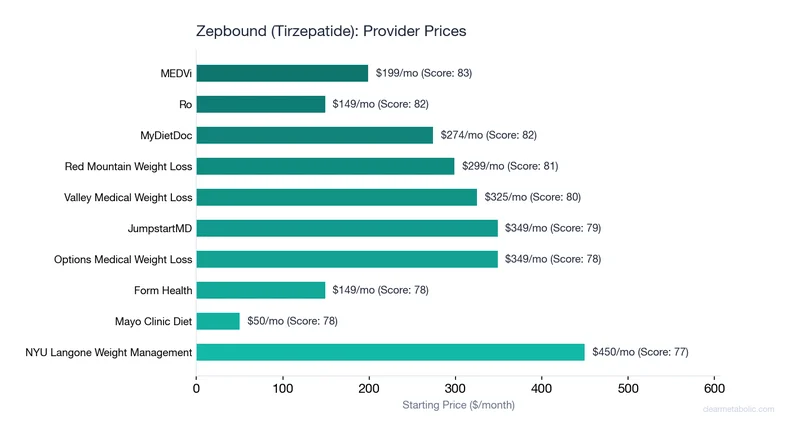
These are the highest-rated telehealth providers offering compounded tirzepatide (the same active ingredient as Zepbound) as of March 2026. ClearScore is our internal rating based on pricing, transparency, medical oversight, pharmacy quality, and user experience.
| Provider | ClearScore | Starting Price | Highlights |
|---|---|---|---|
| MEDVi | 83/100 | $249/mo | Strong clinical support, body composition tracking, 503B pharmacy |
| Ro | 82/100 | $149/mo | Largest telehealth platform, brand-name Zepbound + compounded options, insurance concierge |
| Red Mountain Weight Loss | 81/100 | $299/mo | Medical weight loss specialists, in-person and virtual options |
| Mochi Health | 77/100 | $49 to $69/mo + $99 to $199/mo meds | Low membership fee, medication billed separately, growing platform |
| Calibrate | 76/100 | $199/mo | Metabolic health focus, coaching included, structured program |
Some of these providers also offer brand-name Zepbound (not just compounded tirzepatide). Ro, for example, offers brand-name Zepbound at $299 to $449+ per month on top of their membership fee, with an insurance concierge to help get coverage.
For the full provider list with current pricing, visit our provider comparison directory. For the cheapest options specifically, see our cheapest GLP-1 guide.
Common Side Effects
Zepbound’s side effects are identical to Mounjaro’s because the drug is the same. Most are gastrointestinal and worst during dose escalation.
Most common:
- Nausea (12 to 18% of clinical trial participants, depending on dose). This is the side effect people talk about most. In my experience, it was manageable. It hit hardest in the first five to seven days after each dose increase, then faded.
- Diarrhea (12 to 17%). More common at higher doses and during the first weeks of treatment.
- Constipation (6 to 11%). The opposite GI issue. Extra fiber, water, and walking help.
- Decreased appetite. The intended effect, but it can feel intense early on. Make sure you are still getting enough protein. Aim for at least 0.7g per pound of body weight daily.
- Injection site reactions. Mild redness or itching at the injection spot. Usually temporary.
- Fatigue. Some people feel tired, especially when eating significantly less in the first weeks at a new dose.
Serious side effects (rare):
- Pancreatitis (seek immediate medical attention for severe, persistent abdominal pain)
- Gallbladder problems (rapid weight loss increases the risk of gallstones)
- Thyroid C-cell tumors (observed in animal studies, boxed warning on label)
- Hypoglycemia (higher risk when combined with insulin or sulfonylureas)
Zepbound is contraindicated in people with a personal or family history of medullary thyroid carcinoma or Multiple Endocrine Neoplasia syndrome type 2.
For a detailed guide on managing these effects, see our GLP-1 side effects guide.
How Zepbound Compares to Other GLP-1 Drugs
Zepbound vs Mounjaro: Same drug. Same molecule. Same doses. Zepbound is FDA-approved for weight management. Mounjaro is approved for type 2 diabetes. Your choice between them comes down to your diagnosis and which one your insurance covers. See our Mounjaro vs Zepbound breakdown.
Zepbound vs Wegovy: Different molecules, different mechanisms. Zepbound (tirzepatide, dual GIP/GLP-1) outperformed Wegovy (semaglutide, GLP-1 only) in the SURMOUNT-5 head-to-head trial: 20.2% versus 13.7% weight loss. Wegovy does have cardiovascular outcome data from the SELECT trial that tirzepatide lacks (the SURPASS-CVOT trial is ongoing). See our Zepbound vs Wegovy comparison and full four-drug comparison.
Zepbound vs Ozempic: Zepbound works on two receptors. Ozempic works on one. Zepbound is approved for weight loss. Ozempic is approved for diabetes and used off-label for weight loss. If maximum weight loss is your goal and you have access to both, tirzepatide is the stronger option based on current evidence. Full details in our Mounjaro vs Ozempic comparison.
If you hit a plateau on tirzepatide, check out our guide: Mounjaro Weight Loss Plateau.
Frequently Asked Questions
What is the difference between Zepbound and Mounjaro?
They contain the same molecule (tirzepatide) at the same doses, made by the same company (Eli Lilly). The only difference is the FDA-approved indication. Zepbound is approved for chronic weight management in adults with obesity or overweight. Mounjaro is approved for type 2 diabetes. Your doctor will prescribe one based on your diagnosis and insurance.
Is Zepbound covered by insurance?
Coverage is expanding but not universal. Some commercial insurance plans and employer plans now cover Zepbound for weight management. Medicare Part D does not currently cover anti-obesity medications. If your plan does cover it, copays typically range from $25 to $150 per month. Check our insurance coverage guide for tips on getting approved.
How much weight can I lose on Zepbound?
In the SURMOUNT-1 clinical trial, participants on the 15 mg dose lost an average of 22.5% of their body weight over 72 weeks. In the SURMOUNT-5 head-to-head trial against semaglutide, tirzepatide produced 20.2% weight loss. Individual results vary based on dose, diet, exercise, and other factors.
Is compounded tirzepatide the same as Zepbound?
Compounded tirzepatide contains the same active molecule as Zepbound. The difference is that the compounded version is mixed by a licensed compounding pharmacy rather than manufactured by Eli Lilly. Compounded products have not gone through FDA review as finished products. They are legal under FDA shortage policy and are available from $149 to $399 per month. Our compounded vs brand-name guide covers the tradeoffs in detail.
Should I choose Zepbound or Wegovy?
If maximum weight loss is your priority and you can access both, Zepbound (tirzepatide) has stronger clinical data. The SURMOUNT-5 trial showed 47% more weight loss with tirzepatide compared to semaglutide. If cardiovascular protection is a priority, Wegovy has the SELECT trial showing a 20% reduction in major cardiovascular events. Cost and insurance coverage often end up being the deciding factor for most people.
Last updated: March 2026. Pricing and availability may change. This article is for informational purposes only and does not constitute medical advice. Always consult a licensed healthcare provider before starting any medication.