Compounded Semaglutide: Cost, Safety, and Best Providers (2026)
Last updated: April 2026 · Written by Ash at ClearMetabolic
I have been tracking the compounded GLP-1 space since I started my own weight loss journey in 2024. Brand-name semaglutide (Ozempic, Wegovy) costs $892 to $1,349 per month without insurance. For most people paying out of pocket, that is not realistic. Compounded semaglutide changed the equation entirely. It is the same active molecule, produced by compounding pharmacies under FDA shortage rules, at a fraction of the brand-name price.
This page covers everything you need to know about compounded semaglutide in 2026: how it works, what it costs, where to get it, and what safety factors to watch for.
Lowest verified prices this month
Found Health at $129/mo and Yucca Health from $146/mo (6-month plan, free 2-day shipping) are the cheapest compounded semaglutide programs in our 94-provider index.
We may earn a commission from some links. It does not change the price you pay or our rankings. Details.
Quick Facts
| Detail | Info |
|---|---|
| Generic Name | Semaglutide (compounded) |
| Brand-Name Equivalents | Ozempic (diabetes), Wegovy (weight management) |
| Drug Class | GLP-1 receptor agonist |
| Regulatory Status | Permitted under FDA drug shortage policy (status updates periodically) |
| Pharmacy Types | 503A (state-regulated) and 503B (FDA-inspected outsourcing facilities) |
| Price Range | $149 to $299/month through telehealth |
| Brand-Name Price | $892 to $1,349/month (Ozempic/Wegovy without insurance) |
| Route | Subcutaneous injection (weekly) |
| Clinical Weight Loss | ~14.9% body weight at max dose over 68 weeks (STEP 1 trial) |
How It Works
Semaglutide is a GLP-1 receptor agonist. It mimics a natural hormone (glucagon-like peptide-1) that your gut releases after eating. When you inject semaglutide, it does three things:
- Slows gastric emptying. Food stays in your stomach longer, so you feel full sooner and stay full longer after meals.
- Reduces appetite signals in the brain. Semaglutide acts on GLP-1 receptors in the hypothalamus, which is the part of your brain that regulates hunger. The result is a genuine reduction in how much you want to eat.
- Improves insulin sensitivity. This is why semaglutide was originally developed for type 2 diabetes. It helps your body manage blood sugar more effectively.
Compounded semaglutide contains the same active molecule as Ozempic and Wegovy. The difference is who makes it. Novo Nordisk manufactures the brand-name versions in FDA-approved facilities. Compounding pharmacies produce compounded semaglutide under different regulatory rules, mixing the active ingredient into injectable formulations based on individual or bulk prescriptions.
The mechanism of action is identical. Your body responds to the semaglutide molecule the same way regardless of which pharmacy produced it.
How Compounding Works
Compounding pharmacies have existed for decades. They prepare customized medications when a commercially available version does not meet a patient’s needs, or when the commercial version is in shortage.
For GLP-1 medications, the FDA’s drug shortage policy is what opened the door. When Novo Nordisk could not produce enough Ozempic and Wegovy to meet demand, the FDA added semaglutide to its official drug shortage list. Under federal law (Section 503A and 503B of the Federal Food, Drug, and Cosmetic Act), compounding pharmacies can produce copies of drugs that are listed in shortage.
503A Pharmacies vs 503B Outsourcing Facilities
These are two different categories of compounding pharmacy, and the distinction matters for quality and safety.
503A pharmacies are traditional compounding pharmacies regulated primarily by state boards of pharmacy. They prepare medications based on individual patient prescriptions. They are not required to follow FDA current Good Manufacturing Practices (cGMP), and the FDA does not routinely inspect them. Quality standards depend on the state.
503B outsourcing facilities are registered with the FDA. They can produce medications in larger batches without individual prescriptions. They must follow cGMP, submit to regular FDA inspections, and report adverse events. This is a higher standard of oversight.
When you choose a telehealth provider for compounded semaglutide, ask whether their pharmacy partner is a 503A or 503B. I recommend choosing providers that work with 503B outsourcing facilities whenever possible. The FDA inspection requirement adds a layer of quality assurance that 503A pharmacies do not have.
Regulatory Status Is Evolving
The FDA periodically reviews its drug shortage list. If semaglutide is removed from the shortage list, the legal basis for compounding it changes. The FDA issued temporary enforcement guidance in early 2024 allowing a wind-down period for pharmacies that were already compounding semaglutide when it was removed from shortage. Some providers pivoted to compounding semaglutide with additional ingredients (like B12 or L-carnitine) to argue they qualify under a different legal provision.
The bottom line: check the current FDA shortage status before starting compounded semaglutide, and make sure your provider has a clear plan if the regulatory environment shifts.
For the full safety picture, including the FDA’s adverse event data and how to verify a pharmacy before you order, see our standalone guide: Is Compounded Semaglutide Safe? What the FDA Actually Says.
Typical Dosing
Compounded semaglutide typically follows the same titration schedule as brand-name Ozempic and Wegovy. You start at a low dose and increase gradually to minimize side effects.
| Dose | Typical Duration | Notes |
|---|---|---|
| 0.25 mg/week | 4 weeks | Starting dose. Lets your body adjust. |
| 0.5 mg/week | 4 weeks | First therapeutic dose. Most people start feeling appetite changes here. |
| 1.0 mg/week | 4 weeks | Effective dose for many patients. Ozempic max is 2 mg. |
| 1.7 mg/week | 4 weeks | Wegovy titration step. |
| 2.4 mg/week | Maintenance | Maximum dose (Wegovy). Highest weight loss in clinical trials. |
Your prescriber should adjust the schedule based on how you respond. Some people stay at a lower dose if they are getting good results without significant side effects. Others may need the full 2.4 mg to see meaningful progress.
What It Costs in 2026
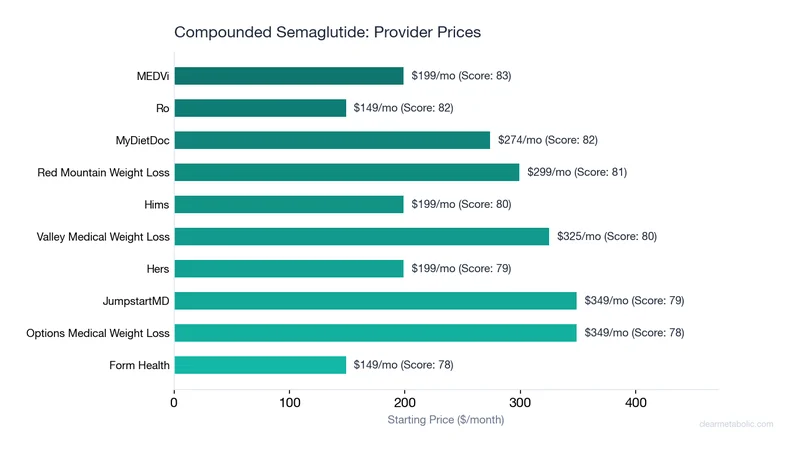
Compounded semaglutide is dramatically cheaper than brand-name Ozempic or Wegovy. Here is what the major telehealth providers charge as of early 2026.
| Provider | ClearScore | Monthly Cost | What's Included |
|---|---|---|---|
| MEDVi | 83/100 | $199/mo | Medication, provider consultations, ongoing support |
| Ro | 82/100 | $149/mo | Medication, online evaluation, home delivery |
| Red Mountain Weight Loss | 81/100 | $299/mo | Medication, clinical support, body composition tracking |
| Hims | 80/100 | $199/mo | Medication, provider check-ins, free shipping |
| Hers | 79/100 | $199/mo | Medication, provider check-ins, free shipping |
For comparison, brand-name Ozempic runs about $892/month and Wegovy about $1,349/month at retail without insurance. Compounded semaglutide saves you $600 to $1,200 per month depending on the brand and the provider you choose. For the full breakdown across 67 compounded semaglutide programs, see our 2026 GLP-1 Cash-Pay Pricing Index (median is $199/month).
Prices can vary based on your dose level. Some providers charge the same flat rate regardless of dose. Others increase the price as you move to higher doses. Always ask about pricing at your target maintenance dose, not just the starting dose.
For a deeper look at all the affordable options, check our cheapest GLP-1 online guide.
Looking for the best price on compounded semaglutide?
Compare 40+ telehealth providers side by side, sorted by price and ClearScore.
Compare Providers →Where to Get It Online: Top 5 Providers by ClearScore
Here is a quick overview of the top-rated providers offering compounded semaglutide, ranked by our ClearScore methodology.
1. MEDVi (ClearScore: 83/100)
MEDVi pairs compounded semaglutide with clinical support including ongoing body composition tracking. They work with 503B outsourcing facilities and offer regular provider check-ins. At $199/month, they are positioned in the middle of the price range but score well on clinical support and pharmacy quality.
2. Ro (ClearScore: 82/100)
Ro is one of the largest telehealth platforms in the US and offers compounded semaglutide at $149/month, making it one of the most affordable options. Their process includes an online medical evaluation, prescriber consultation, and direct-to-door delivery. The platform is straightforward and well-established.
3. Red Mountain Weight Loss (ClearScore: 81/100)
Red Mountain has brick-and-mortar clinics in addition to their telehealth program. Their compounded semaglutide runs $299/month, which is on the higher end. The extra cost gets you more hands-on clinical support and in-person options if you prefer that approach.
4. Hims (ClearScore: 80/100)
Hims offers compounded semaglutide through its weight loss program at $199/month. The platform bundles medication with provider consultations and ships directly to your home. Hims has strong brand recognition and a smooth onboarding process.
5. Hers (ClearScore: 79/100)
Hers is the women-focused counterpart to Hims, offering the same compounded semaglutide at $199/month. The clinical program and pharmacy sourcing are essentially the same. If you prefer a platform marketed toward women, Hers is the direct equivalent.
Safety Considerations
Compounded semaglutide contains the same active ingredient as Ozempic and Wegovy, but “same molecule” does not mean “identical product.” The safety profile depends heavily on where and how the medication is compounded.
Quality Varies Between Pharmacies
Not all compounding pharmacies are equal. A 503B outsourcing facility that follows cGMP and undergoes FDA inspections is held to a much higher standard than a small 503A pharmacy with only state oversight. The FDA has issued warning letters to compounding pharmacies producing semaglutide with quality issues, including incorrect concentrations, sterility problems, and use of semaglutide salt forms that differ from the FDA-approved molecule.
What to Look For
When choosing a provider for compounded semaglutide, ask these questions:
- Is the pharmacy a 503B outsourcing facility? This is the gold standard for compounding. 503B facilities are FDA-registered, follow cGMP, and submit to regular inspections.
- What form of semaglutide do they use? The FDA-approved form is semaglutide base. Some compounders have used semaglutide sodium, which is a different salt form that has not been studied in the same clinical trials. The FDA has raised concerns about this distinction.
- Do they provide third-party testing? Reputable compounders test their products for potency, sterility, and endotoxins. Ask if results are available.
- Does the provider require a prescription? Any legitimate provider will require a medical evaluation and prescription. If you can buy semaglutide without a prescription, walk away.
Avoiding Counterfeit Products
The FDA has warned about counterfeit and substandard semaglutide products, particularly those sold online without prescriptions or imported from overseas. Stick with US-based telehealth providers that work with US-based compounding pharmacies. Avoid sellers on social media, unregulated online marketplaces, or anyone offering semaglutide at suspiciously low prices without a medical evaluation.
Common Side Effects
The side effects of compounded semaglutide mirror those of brand-name semaglutide. The molecule is the same, so your body responds the same way.
The most common side effects are gastrointestinal:
- Nausea is the number one complaint. It is usually worst in the first 1 to 2 weeks after starting or increasing the dose. Eating smaller meals and avoiding greasy food helps.
- Diarrhea is common in the early weeks and usually improves.
- Constipation affects some people instead of (or in addition to) diarrhea. Fiber and hydration make a real difference.
- Decreased appetite is the intended effect, but it can feel extreme at first. Some people barely want to eat anything in the first few weeks.
- Injection site reactions like mild redness or itching. Generally minor.
- Fatigue and headaches are reported by some people, especially at higher doses.
Serious side effects are rare but include pancreatitis, gallbladder issues (rapid weight loss itself increases gallstone risk), and a boxed warning about thyroid C-cell tumors observed in animal studies.
For a detailed breakdown, read our GLP-1 side effects guide.
Compounded Semaglutide vs Brand-Name: How Do They Compare?
The active molecule is the same. The differences come down to manufacturing standards, regulatory oversight, and cost.
Brand-name Ozempic and Wegovy are manufactured by Novo Nordisk in FDA-approved facilities, come in pre-filled auto-injector pens, and are backed by the clinical trial data that earned FDA approval. They are also $892 to $1,349 per month without insurance.
Compounded semaglutide is produced by compounding pharmacies, typically comes in multi-dose vials (you draw up your own dose with a syringe), and costs $149 to $299 per month. The trade-off is less regulatory oversight and the need to do your own due diligence on pharmacy quality.
For most people paying out of pocket, compounded semaglutide is the realistic path to accessing this medication. The key is choosing a reputable provider that works with a quality pharmacy.
We cover this topic in depth in our compounded vs brand-name GLP-1 guide.
Frequently Asked Questions
Is compounded semaglutide the same as Ozempic?
Compounded semaglutide contains the same active ingredient as Ozempic. The molecule is identical. The difference is that Ozempic is manufactured by Novo Nordisk under full FDA manufacturing oversight, while compounded semaglutide is prepared by compounding pharmacies under either state (503A) or FDA (503B) regulation. The clinical trials that demonstrated semaglutide’s efficacy and safety were conducted with the Novo Nordisk product. Compounded versions have not undergone separate clinical trials, but the pharmacology is the same.
Is compounded semaglutide legal?
Yes, under the FDA’s drug shortage framework. When semaglutide is listed on the FDA’s official drug shortage list, compounding pharmacies are legally permitted to produce it. The regulatory situation around GLP-1 compounding has been fluid, with the FDA updating shortage status and enforcement policies multiple times. Always verify the current status with your provider.
How long can I stay on compounded semaglutide?
There is no fixed time limit. Many people use semaglutide (compounded or brand-name) as a long-term medication, similar to blood pressure or cholesterol drugs. Clinical data shows that most people regain weight after stopping GLP-1 medications. Your provider will work with you on a long-term plan. Some people eventually transition to brand-name if insurance coverage becomes available. Others stay on compounded versions indefinitely.
What happens if the FDA removes semaglutide from the shortage list?
If the FDA determines the semaglutide shortage has been resolved, compounding pharmacies lose their legal basis for producing it (unless they are compounding a clinically different product). The FDA has previously provided wind-down periods to avoid abrupt disruption for patients. Your telehealth provider should have a transition plan. This is worth asking about before you start.
Can I get compounded semaglutide without insurance?
Yes. In fact, most people getting compounded semaglutide are paying out of pocket. Insurance typically does not cover compounded medications. The whole appeal of compounded semaglutide is that it is affordable without insurance, running $149 to $299 per month depending on your provider. For more options, see our guide on getting GLP-1s without insurance.